The correct choice depends first on who is allowed to ride, then on the load, duty cycle, site conditions and safety classification. By the end, you will have a practical specification, supplier-comparison checklist and commissioning plan for selecting equipment that works reliably in a Surat factory.
Key takeaways
- Decide first whether people are permitted to ride in the lift.
- Specify load, car dimensions, travel height and daily duty cycle.
- Choose traction or hydraulic equipment around the building and production process.
- Compare suppliers on response time, spare parts and total downtime.
Decide whether you need a goods lift, material lift or industrial lift
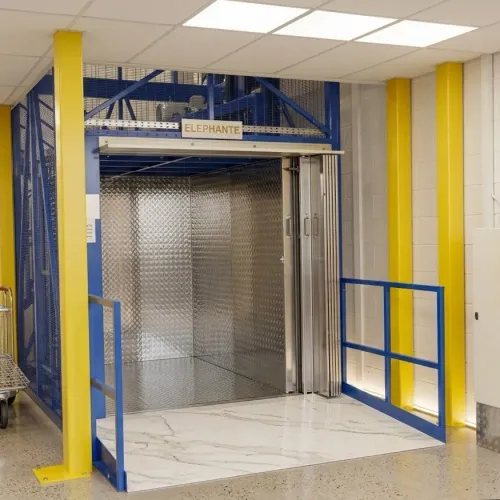
Choose the classification before asking for capacity: goods lift, material lift, industrial lift and service lift are not interchangeable procurement terms. Decide whether operators, maintenance staff or any other people may ride in the car.
- Use a material-only hoist for pallet movement between production floors when no person enters the car.
- Specify an industrial or goods lift for textile-roll handling and machine-part transfer when loads require stronger floors, wider doors or repeated factory cycles.
- Choose a passenger-rated or dual-purpose lift for mixed goods-and-person service, including authorised operators or maintenance staff travelling with the load.
A hoist intended exclusively for materials can have a different legal and safety classification from a lift designed to carry people with goods. A large platform does not make a material-only unit safe for personnel; it may lack the doors, interlocks, controls, emergency communication and protective systems required for riders.
Put this decision at the beginning of the enquiry, then record it in the tender, general-arrangement drawings and operating procedure. Treat “industrial lift or goods lift in Surat” as a buying question, not proof that two quotations describe equivalent equipment. Ask each supplier to state the permitted occupants, prohibited use and applicable classification in writing.
If people must ride, reject any quotation that describes the equipment only as a material lift without a passenger-rated or dual-purpose design.
Specify the factory goods lift by load, dimensions and duty cycle
A 1,000 kg label does not prove that a 1,000 kg pallet or forklift is suitable. Specify the factory goods lift in Surat by usable payload and by the conditions under which that payload will be loaded.
1. State the rated load in kilograms, then identify whether it includes the car, sling, platform or fittings. Record the usable payload separately, along with car length and width, clear door opening, number of landings, travel, rated speed and loading method.
2. Put the design basis in writing: pallet dimensions, trolley dimensions, forklift wheel loads, wheelbase, loading impact and off-centre loading. A pallet may fit the doorway yet overload the floor locally, while a forklift may exceed the permitted wheel load even below the stated capacity.
3. Require a load-duty calculation showing starts per hour, operating hours per shift, peak loading periods and expected repeated cycles. Use it to size and verify the brake, motor, controller and door operator; for hydraulic equipment, check oil heating during those cycles.
Protect the landing separately from the lift rating. Show wheel stops, barriers, suitable dock plates, level transitions and a written procedure that prevents a trolley or forklift from striking the sill or landing door. Include the impact of uncontrolled pallet movement in the design review.
Match traction or hydraulic equipment to the building and process
Choose traction for higher travel and frequent cycling; choose hydraulic equipment when a low-rise factory needs heavy-load lifting with simpler machinery placement.
| Drive arrangement | Best fit | Main checks |
|---|---|---|
| Traction | Multi-storey travel and repeated cycles | Rope, sheave, brake, guide and controller wear; efficient operation at frequent starts |
| Hydraulic | Low-rise, heavy-load applications | Oil temperature, leakage containment, cylinder condition and reduced performance if overheated |
Before fabrication, agree these items on the civil and lift drawings:
- Pit depth, overhead clearance, shaft plumbness and every landing sill level.
- Rail-bracket fixing details, supplier reaction loads and the structure receiving those loads.
- Machine-room or controller space, ventilation, drainage and safe maintenance access.
- Textile, chemical and dyeing areas: corrosion-resistant finishes, electrical-enclosure ingress protection, wash-down limits, ambient-temperature range and oil containment.
- Foundry and dusty areas: dust control, enclosure protection and temperature limits.
- Explosive or combustible atmospheres: separately certified equipment, not a standard lift package.
A shaft is an engineered installation, not merely a hole in the floor. The supplier must coordinate these interfaces before fabrication; otherwise misplaced fixings, inadequate clearances or unplanned drainage can force costly structural changes and restrict maintenance.
Demand named standards, safety functions and witnessed acceptance tests
Reject any quotation that says only “as per IS standard.” Require industrial elevator suppliers in Surat to name the applicable Indian Standard, edition and relevant parts, then submit the electrical single-line diagram, safety-circuit description, general arrangement drawings, reaction loads, test records and statutory-inspection documents.
- List landing-door and car-door interlocks, prevention of movement with an open door, overspeed protection where applicable, terminal stopping, buffers or equivalent end-of-travel protection, emergency alarm or communication, overload protection and controlled rescue after power failure.
- State what happens to rated load during mains failure, whether automatic rescue or emergency lowering can move that load, which doors may be released, and the limits for door release. These devices do not by themselves make a trapped person or trapped load safe.
- Name authorised rescuers, their training and the restart-prevention method. The lift must not return to service after a rescue until the specified checks are complete.
Witness commissioning tests rather than accepting brochure claims. Run the empty car and rated load at every landing, check both door interlocks, stopping accuracy, alarm, emergency stop, power-failure behaviour and repeated cycles. Record abnormal noise and vibration, and measure car dimensions and clear openings against the approved drawings.
A no-load demonstration will not expose load-dependent stopping, door or drive faults.
Compare Surat suppliers by maintenance response, spares and total downtime
A low purchase price is not a low-cost lift if a failed controller keeps production stopped for three days. Compare industrial lift manufacturers in Surat by preventive-maintenance coverage, parts access and total downtime, not by quarterly lubrication alone.
The business can add practical value when its team coordinates site access, commissioning records and local breakdown support.
Ask each supplier to document:
- Inspection of door locks and rollers, brakes, ropes or chains, guide shoes, buffers, limit switches, controller fault logs, emergency devices, hydraulic oil and leakage where applicable, plus periodic safety testing.
- Guaranteed response times, rescue support, planned shutdown windows, critical-spares stock, technicians trained on the quoted controller and drive, and a written breakdown-escalation route.
- Whether the door operator, controller, hydraulic valve and safety components are proprietary, with replacement-part lead times and all exclusions stated in the order.
- Bollards or barriers and protected landing doors wherever forklifts operate; these prevent impact that the lift’s rated capacity does not address.
Supplier comparison should look like this:
| Supplier offer | What you are really comparing | Downtime risk |
|---|---|---|
| Lowest-price contract | Lubrication, call-out service and long parts lead times | High if proprietary parts are unavailable |
| Full preventive-maintenance contract | Component inspections, fault-log review, testing and scheduled shutdowns | Lower and easier to plan |
| Local OEM-supported service | Trained technicians, critical spares and escalation access | Lowest when response times are contractually guaranteed |
Compare the purchase price with service access, expected downtime and five-year operating risk before signing.
Frequently asked questions
How do you choose between a goods lift, material lift and industrial lift?
Start by deciding whether operators, maintenance staff or other people may ride in the car. Then match the lift classification to the factory task and operating conditions.
What details should a factory goods lift specification include?
State the rated load, car dimensions, door dimensions, travel height, floor stops, loading method and expected duty cycle.
When is traction or hydraulic equipment suitable for a factory lift?
Match the system to the building’s travel height, available machine-room or pit space, loading pattern, speed requirement and production environment.
What should you ask Surat industrial lift suppliers to prove?
Request named standards, documented safety functions, inspection records and witnessed acceptance tests, then compare maintenance response and spare-parts support.
Keywords