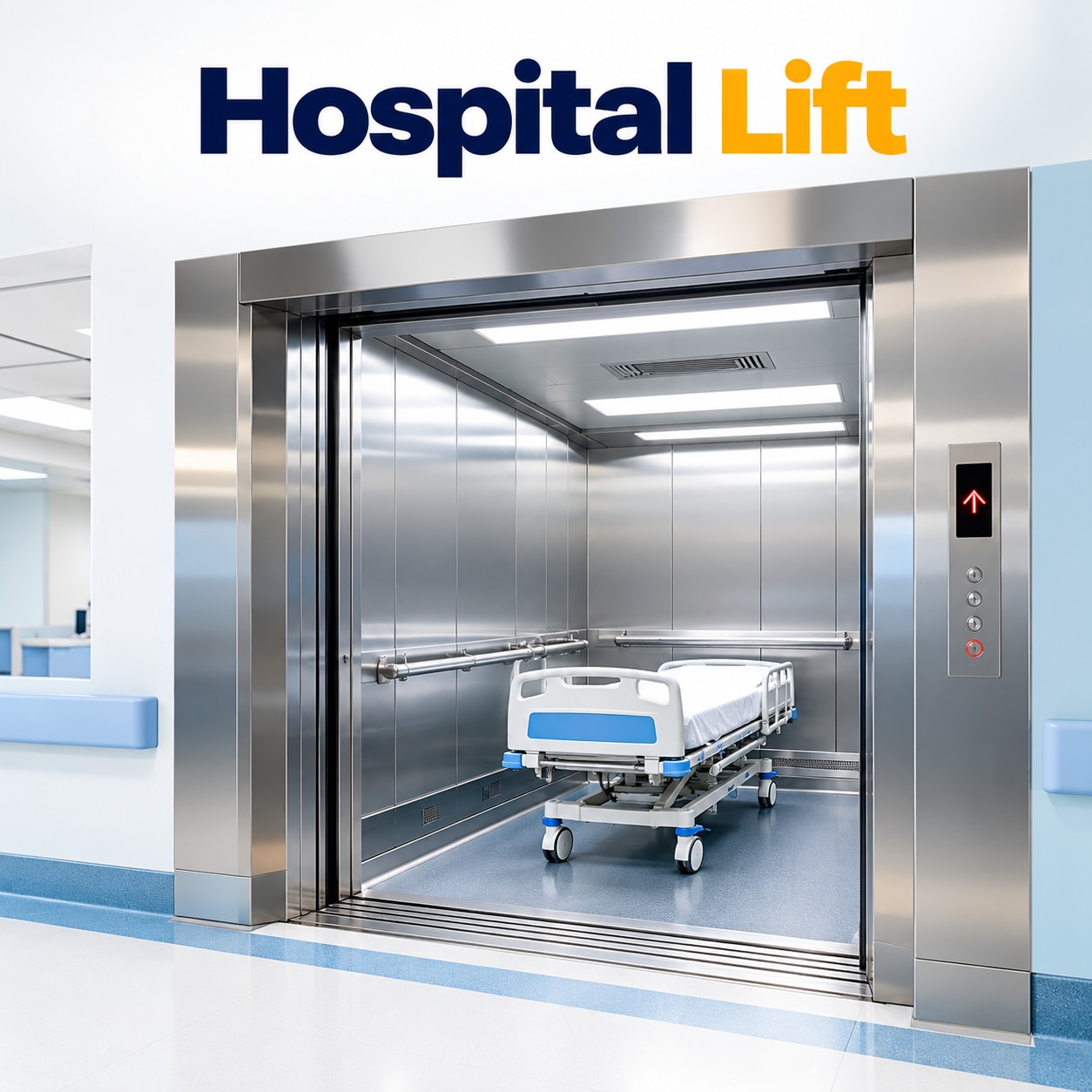
Choosing the wrong lift type can create delays for bed transfers, trip hazards at the landing, generator faults and difficult cleaning routines. By the end, you will know how to separate passenger, bed and fire-service roles, what to put in the tender, and which installation and handover checks protect hospital operations.
Key takeaways
- Choose a bed lift for occupied patients, stretchers, trolleys and bulky clinical equipment.
- Specify clear car dimensions, door width, load rating and stretcher turning space.
- Document generator operation, power-failure rescue, drainage and monsoon protection in the tender.
- Accept the lift only after testing alarms, emergency communication, leveling, doors and backup operation.
Which lift type matches the movement your healthcare building must handle?
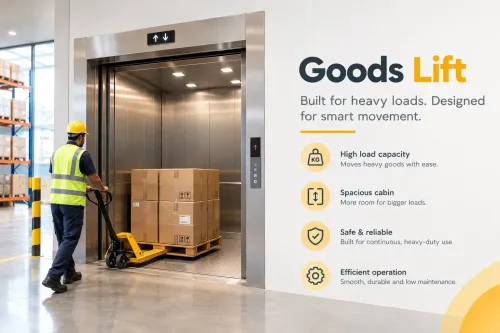
Choose a dedicated bed or stretcher lift when the car must carry an occupied patient, a bulky clinical trolley or critical equipment. Assess a general passenger elevator separately for visitors and staff; passenger capacity alone does not prove that a bed will fit.
| Lift type | What it handles | Decision test |
|---|---|---|
| General passenger elevator | Visitors, staff and ambulant patients | Use only after checking traffic, cleaning and infection-control requirements |
| Bed or stretcher lift | Occupied beds, stretchers, attendants and equipment | Specify the largest bed, loading direction, door opening and turning radius |
| Fireman’s lift | Fire-service access under its designated operating mode | Do not treat fireman’s service as a compliant emergency evacuation lift |
| Separate cars | Distinct visitor, clinical, service or emergency flows | Choose when food, waste, patients and emergency transfers conflict |
A 1,000 kg passenger car can still reject an occupied bed because its clear door opening, car depth or internal turning space is inadequate. Measure the largest stretcher or bed with mattress, oxygen cylinder, monitors and the required attendants, then test the loading route at every floor.
Using one car for visitors, patients, meals, waste and emergency transfers creates delays, contamination concerns and priority disputes. For a hospital lift or passenger elevator in Surat, choose separate cars when traffic peaks overlap or clinical transfers need controlled priority; never solve a layout problem by increasing rated load alone.
Ask for a bed or stretcher lift when occupied-patient movement is part of the building’s normal operation.
What dimensions and performance details belong in the lift tender?
Specify usable geometry and measured behaviour, not rated load and speed alone. A 1,000 kg car can fail clinically if its clear door opening is too narrow, or its internal layout cannot turn the largest occupied bed, stretcher, attendant and equipment combination.
Require every tenderer, including hospital lift manufacturers in Surat, to submit a clause-by-clause schedule covering:
- Largest bed or stretcher envelope, attendant and equipment load, loading direction, clear door opening, car dimensions and turning space.
- A General Arrangement drawing showing car size, clear door opening, shaft size, pit depth, overhead clearance, machine-room or machine-room-less arrangement, and structural reaction loads.
- Levelling accuracy, smooth acceleration, door dwell time, re-opening behaviour, peak handling requirement and traffic zoning.
- Car finishes, handrails, wall impact protection and controls that withstand hospital cleaning.
| Compare | Proposal with similar rated load | Proposal meeting the clinical requirement |
|---|---|---|
| Car geometry | May offer less usable width or turning space | Fits the stated bed, stretcher and equipment envelope |
| Door operation | Narrow opening or slow re-opening delays transfers | Wide, unobstructed opening with defined dwell and safety response |
| Traffic performance | Speed quoted without peak handling or zoning | Priority, visitor, service and emergency traffic are allocated |
Reject decorative joints, exposed ledges and difficult-to-clean controls: they trap dirt and increase housekeeping effort. Ask hospital lift manufacturers in Surat for measured, clause-by-clause responses, not a brochure that lists only capacity and speed.
How should power failure, generator operation and monsoon risks be specified?
Specify either an automatic rescue device or generator supply; battery-backed emergency lighting does not keep the lift operating during a power failure. State the available number of rescue trips or operating duration, how doors will open at the landing, and the connection point to the hospital’s essential-power distribution.
1. Require healthcare elevator suppliers in surat to submit the lift’s power-failure sequence, including automatic rescue, generator changeover, door release, and return-to-service behaviour.
2. Coordinate the elevator controller with the electrical consultant. Record starting current, regenerative or non-regenerative drive behaviour, phase-sequence protection, generator changeover time, and priority logic when several lifts restart together. A nominally adequate generator can nuisance-trip without these values.
3. Survey the pit before civil work. Document groundwater level, pit drainage, sump-pump capacity and reliability, shaft seepage, monsoon water entry, and corrosion exposure. Specify waterproofing and a written water-management plan; a drain or pump does not replace either. Water can damage buffers, travelling cables, door equipment and safety circuits.
4. For a machine-room-less lift, show safe maintenance and rescue access to the motor, brake, governor, controller and rescue equipment. Saved floor area is not a safe design if technicians need improvised access.
5. Before handover, witness and record battery rescue, generator operation, loss-and-restoration sequences, full-load operation, overload protection, levelling, brake and safety-gear operation, door safety devices, alarm and two-way communication. A running demonstration alone is inadequate.
What should hospital elevator installation in Surat include before the lift is accepted?
Acceptance starts with a signed site survey, not the first ride. For hospital elevator installation in Surat, require a measured general arrangement drawing showing car dimensions, clear door opening, shaft size, pit depth, overhead clearance, machine-room or machine-room-less layout and structural reaction loads.
The survey record should confirm:
- Shaft dimensions, pit waterproofing, groundwater level, drainage, sump-pump reliability, seepage, monsoon entry and corrosion exposure
- Overhead clearance, lifting routes, machine access and safe rescue access
- Electrical supply, starting current, phase-sequence protection, generator connection, changeover time and restart priority
- Generator or automatic rescue device capacity, available trips or operating duration and door-opening provisions
Waterproofing still matters when a drain or pump exists; pit water can damage buffers, travelling cables, door equipment and safety circuits.
The installer must also name the exact editions and clauses of each applicable Indian lift standard, the National Building Code provisions adopted by the project, and the Gujarat approval and inspection documents required, rather than claiming “ISI compliant”.
Commissioning evidence should distinguish these records:
| Test or document | Acceptable evidence | Inadequate evidence |
|---|---|---|
| Full-load, overload and power tests | Witnessed result with readings and sequence | Lift carries people once |
| Safety and rescue tests | Brake, governor, safety gear, alarm, communication and battery-rescue records | Verbal assurance |
| Statutory acceptance | Submitted and issued Gujarat inspection documents | “Approval pending” |
Witness door light curtains or safety edges, levelling, fireman’s service where specified, generator operation, and loss-and-restoration-of-power sequences. The business can support this control through measured drawings, electrical coordination, site supervision and recorded test results. A running demonstration alone is not a handover record.
How do you protect uptime after handover?
Protect uptime by buying a defined service commitment, not the lowest annual AMC price. A cheap contract can leave the lift idle if it excludes the parts that cause the longest delays.
1. Require the AMC to state preventive-visit frequency, statutory inspection support, breakdown response time, passenger-rescue attendance time, critical-spares availability and remote-monitoring responsibilities.
2. Mark exclusions line by line. Check whether door operators, batteries, safety circuits, ropes, traction sheaves and vandal-damaged controls are chargeable extras; their exclusion can turn a low fee into prolonged downtime.
3. Set measurable escalation rules. Name the contact for an initial call, the supervisor for missed response targets and the person authorised to release emergency spares. Require service reports recording fault, arrival time, repair and return-to-service time.
4. Do not accept handover without a controlled file containing approved drawings, equipment schedules, test certificates, generator-interface records, rescue instructions, maintenance logs and contact escalation details. A running demonstration without recorded results proves little.
5. Confirm the operating result after handover: accurate levelling, dependable door opening and re-opening, recoverable power failures, working alarms and two-way communication, and fast attended rescue.
6. Choose a passenger elevator only after assessing visitor and staff traffic, cleaning, infection-control separation, bed dimensions and emergency-priority demands. Choose a dedicated hospital lift when clinical movement requires controlled space and priority. The correct label is less important than safe levelling, reliable doors and documented response performance.
Frequently asked questions
How do you choose between a hospital lift and a passenger elevator in Surat?
Choose a dedicated bed or stretcher lift when the car must carry an occupied patient, bulky clinical trolley or critical equipment. Assess a passenger elevator separately for visitors and staff; passenger capacity alone does not prove that a bed will fit.
What dimensions and performance details belong in a healthcare lift tender?
State the clear car width and depth, door opening width, rated load, travel speed, number of stops, door type, stretcher turning space, leveling accuracy, finishes and required operating modes. Base the dimensions on the largest bed, trolley and equipment combination the building will move.
How should a hospital lift tender address power failure and monsoon conditions?
Specify generator supply, automatic rescue operation, emergency lighting, alarm and two-way communication, restart behaviour and priority control. Include protection against water entering the shaft or machine area, suitable drainage and inspection of pit waterproofing before handover.
What should hospital elevator installation in Surat include before acceptance?
Test every landing door, interlock, alarm, emergency communication system, overload function, leveling response, direction control, fire-related operating mode and generator cycle. Record test results, drawings, manuals, certificates, maintenance requirements and staff training.
How do you protect healthcare lift uptime after handover?
Use a preventive maintenance schedule based on door cycles and operating conditions, keep critical spares available, log faults and response times, and test generator and emergency functions at defined intervals. Give the maintenance team access to service records and approved troubleshooting procedures.
Keywords