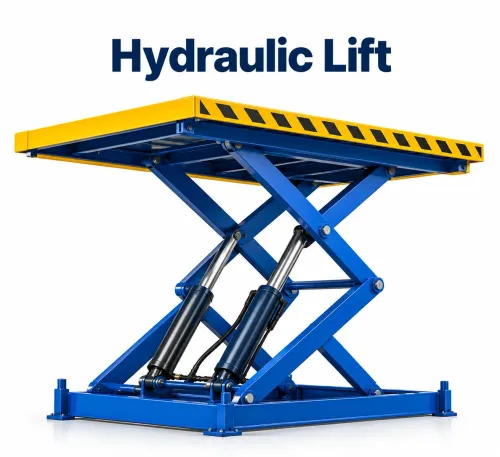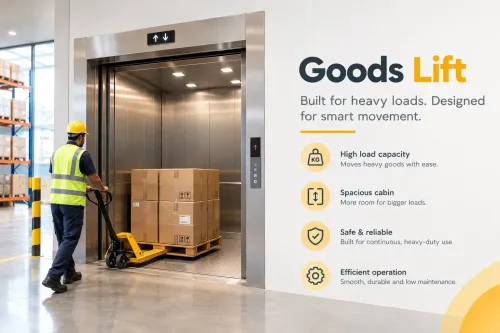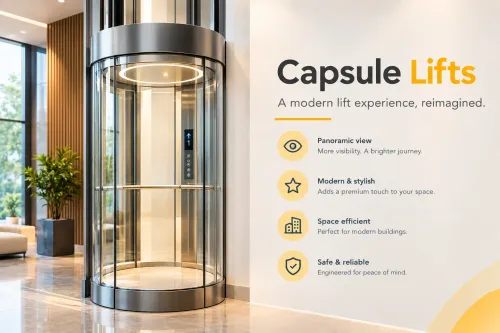
Choosing a hydraulic lift for a low-rise building involves more than comparing passenger capacity and purchase price. By checking the lift arrangement, duty rating, site requirements, quotation exclusions, rescue provisions and maintenance scope, you can distinguish a suitable supplier from a superficially cheaper bid.
Key takeaways
- Choose the hydraulic arrangement after measuring shaft, pit and machine-room space.
- Compare capacity, speed and heat management as one operating specification.
- Require written costs for civil work, installation, testing and emergency systems.
- Tie AMC terms to response times, preventive visits and measurable acceptance tests.
Choose the Hydraulic Arrangement Before Comparing Suppliers
Start with the shaft, pit and equipment footprint, not the supplier’s catalogue. For most low-rise buildings, a conventional hydraulic lift with a separate machine room suits moderate travel and low-to-medium traffic. The room houses the pump, motor, reservoir and controller; “no overhead machine room” only means the drive equipment is not above the shaft.
| Configuration | Best fit | Site consequence |
|---|---|---|
| Direct-acting in-ground | New construction with adequate ground depth | Requires a deep cylinder bore, soil coordination and protection against groundwater |
| Holeless hydraulic | Existing buildings or sites where deep drilling is impractical | Uses cylinders beside or behind the car, but consumes more shaft width and limits travel |
| Roped hydraulic | Greater travel within a low-rise building | Adds sheaves, rope equipment and overhead clearance, increasing inspection points |
Hydraulic lifts in Surat are commonly specified around 0.3–0.75 m/s for low-rise use. Select speed alongside expected starts per hour and daily trips: faster travel and frequent cycles generate more heat and demand stronger cooling, valves and maintenance access.
Ask hydraulic lift suppliers in Surat to show the machine-room plan, service access, shaft dimensions and oil-cooling method. Reject an arrangement that fits the drawing but leaves no safe route to the pump or controller.
Specify emergency lowering or manual lowering, alarm, two-way communication and accessible instructions. Require a demonstrated rescue procedure; a battery-backed light alone will not return passengers to a landing.
Compare Capacity, Speed and Heat Management as One Specification
Rated load, car dimensions, speed, duty cycle and heat capacity must be read together; one impressive figure cannot prove that a lift will handle your building’s traffic. Ask hydraulic elevator manufacturers in Surat to state every figure in the quotation, not just “six-person lift.”
| Figure | What to compare | Warning sign |
|---|---|---|
| Rated load | Kilograms, car size, clear door opening and expected passenger or goods mix | Same load paired with a smaller car or narrow door |
| Traffic duty | Rated speed, starts per hour, expected daily trips, stops and total travel | Speed quoted without starts per hour or daily trips |
| Heat management | Reservoir capacity, motor duty rating, oil-temperature monitoring and thermal protection | No maximum traffic pattern or temperature protection |
For low-rise hydraulic lifts in Surat, 0.3 to 0.75 m/s is a common speed range. Higher speed does not automatically improve service: frequent upward trips generate more heat, increase valve complexity and raise maintenance demand.
Give the supplier your actual number of stops, travel distance, peak-period trips and expected daily usage. Compare the proposed cycle time against that demand, then ask how long the lift can run before oil temperature limits reduce availability.
A low quotation that omits reservoir sizing or motor duty can fail first in an apartment, clinic or busy commercial building.
Check the Pit, Machine Room and Emergency Systems Before Ordering
Confirm the shaft dimensions, pit construction and equipment access on a drawing before signing a quotation. A low-rise hydraulic lift still needs a machine room or equipment space for the pump, motor, reservoir and control cabinet; “no overhead machine room” only means the equipment is not above the shaft.
1. Verify the pit depth, clear shaft dimensions, door openings, base slab strength, waterproofing, drainage and safe access. A leaking or undersized pit can delay installation and damage the cylinder or electrical equipment.
2. Ask for the machine-room plan, ventilation, working clearance, lockable access, lifting route for the motor and reservoir, and protection from flooding. Confirm whether shaft construction, pit ladder, builder’s work and reinstatement are included.
3. Require a dedicated power supply, lockable isolator, correctly sized cabling, earthing and protection devices. Confirm fire-rated doors, smoke or fire-system interfaces and local authority requirements before civil work starts.
4. Obtain the proposed safety standard, Gujarat lift approval and inspection route in writing. Confirm who submits drawings, arranges statutory testing and pays inspection or licensing fees.
5. Test the emergency lowering or manual-lowering method, alarm, emergency light and two-way communication. Battery-backed lighting alone cannot rescue a trapped passenger; demand accessible instructions and a rehearsed procedure naming building staff and the maintenance provider.
For hydraulic lift installation in Surat, record these confirmations with the final pit, machine-room and rescue drawings, not only in a sales promise.
Make Supplier Quotations Comparable on Total Installed Cost
Compare every bid against one written scope and a total installed price; the equipment figure alone is not comparable. Ask each hydraulic lift companies in Surat to price the same rated load, car dimensions, clear door opening, stops, travel, speed, starts per hour or duty classification, and expected daily trips.
| Scope item | What the quotation must show | Common cost gap |
|---|---|---|
| Equipment and installation | Lift package, controller, pump, motor, reservoir, doors, freight, erection and testing | A low equipment price excludes freight, insurance or commissioning |
| Civil and access work | Shaft, pit, waterproofing, machine-room construction, equipment-room access and making good | “No overhead machine room” still requires space for the pump, reservoir and controls |
| Electrical and safety | Power cabling, isolator, earthing, alarm, two-way communication and emergency lowering equipment | Battery lighting alone does not provide rescue capability |
| Approvals and service | Gujarat inspection or licensing fees, drawings, statutory tests, warranty, AMC, response time and spare-parts terms | An attractive offer leaves approval fees or maintenance outside the price |
Give all hydraulic lift suppliers in Surat the same drawing and require a line-by-line exclusions schedule. Reject “passenger lift” or “six-person lift” without the figures above, because identical nominal capacity can hide different car sizes and duty ratings.
Verify the proposed safety standard, approval route and named rescue contact before comparing totals. Ask how emergency lowering works, where its instructions are mounted, and when staff and technicians will rehearse it.
Whether you shortlist the business or another vendor, require one signed scope, one handover document and one five-year cost view including AMC and likely wear parts.
Use Acceptance Tests and a Detailed AMC to Protect Performance
At handover, do not accept a smooth empty-car ride as proof of performance. Hydraulic lift installation in Surat should be signed off only after documented tests under light and rated load, with results retained by the building owner.
- Record stopping accuracy and re-levelling at every landing under both light and rated-load conditions. Repeat after several trips, because oil temperature, trapped air, valve adjustment and internal leakage can change the result.
- Test door interlocks, landing locks, limit switches, buffers, alarm, two-way communication and pit safety equipment. Record each pass or failure.
- Demonstrate emergency lowering or manual lowering from the car and machine space; a battery-backed light alone is not a rescue system.
- Obtain the rescue procedure, operating instructions, test certificates, commissioning records and evidence of the applicable Gujarat approval and inspection process.
- Require a witnessed rescue drill involving building staff, the maintenance provider and the named person responsible for rescue support.
The AMC must state visit frequency, emergency response time, included parts and escalation contacts. Require inspection of oil level and contamination, hose and cylinder-seal leaks, pump noise, valve performance, doors, guide shoes, pit water and alarm equipment, with dated service reports.
Ask hydraulic elevator manufacturers in Surat to identify spare-parts availability, technician coverage and exclusions in writing. A contract promising only lubrication will not protect a lift whose valve, seals or emergency lowering system fails.
Frequently asked questions
Which hydraulic arrangement suits a low-rise building?
A conventional hydraulic lift with a separate machine room suits moderate travel and low-to-medium traffic when the site has room for the pump, motor, reservoir and controller.
What should you compare beyond lift capacity and speed?
Compare heat management, duty cycle, travel distance, motor and pump selection, controller settings, and the expected traffic pattern together.
What site conditions must you check before ordering?
Measure the shaft, pit and machine-room footprint, then confirm emergency systems, access for maintenance, rescue arrangements and the required civil work.
How do you compare hydraulic lift quotations fairly?
Put equipment, civil work, electrical work, installation, testing, statutory documentation, taxes, exclusions and maintenance costs into a single total-installed-cost comparison.
What should a hydraulic lift AMC include?
Specify preventive-visit frequency, inspection tasks, replacement-part exclusions, response times, entrapment support, emergency contact details and performance checks.
Keywords