A traction lift in a private villa can stop because of its motor, brake, ropes, door interlocks, controller, or guide system—but the building can create the same symptoms through poor power quality, water ingress, heat, dust, or inaccurate shaft construction. By the end, you will be able to identify likely causes, separate lift faults from site faults, and specify the checks needed before installation and during maintenance.
Key takeaways
- Check rope tension, door locks, levelling, and brake operation after every reported fault.
- Protect the lift from Surat’s heat, humidity, dust, rainwater, and voltage fluctuations.
- Demand drawings, load data, rescue instructions, test records, and warranty terms before handover.
- Install a reachable emergency alarm and define who performs power-failure rescue.
How a manual traction lift works in a villa
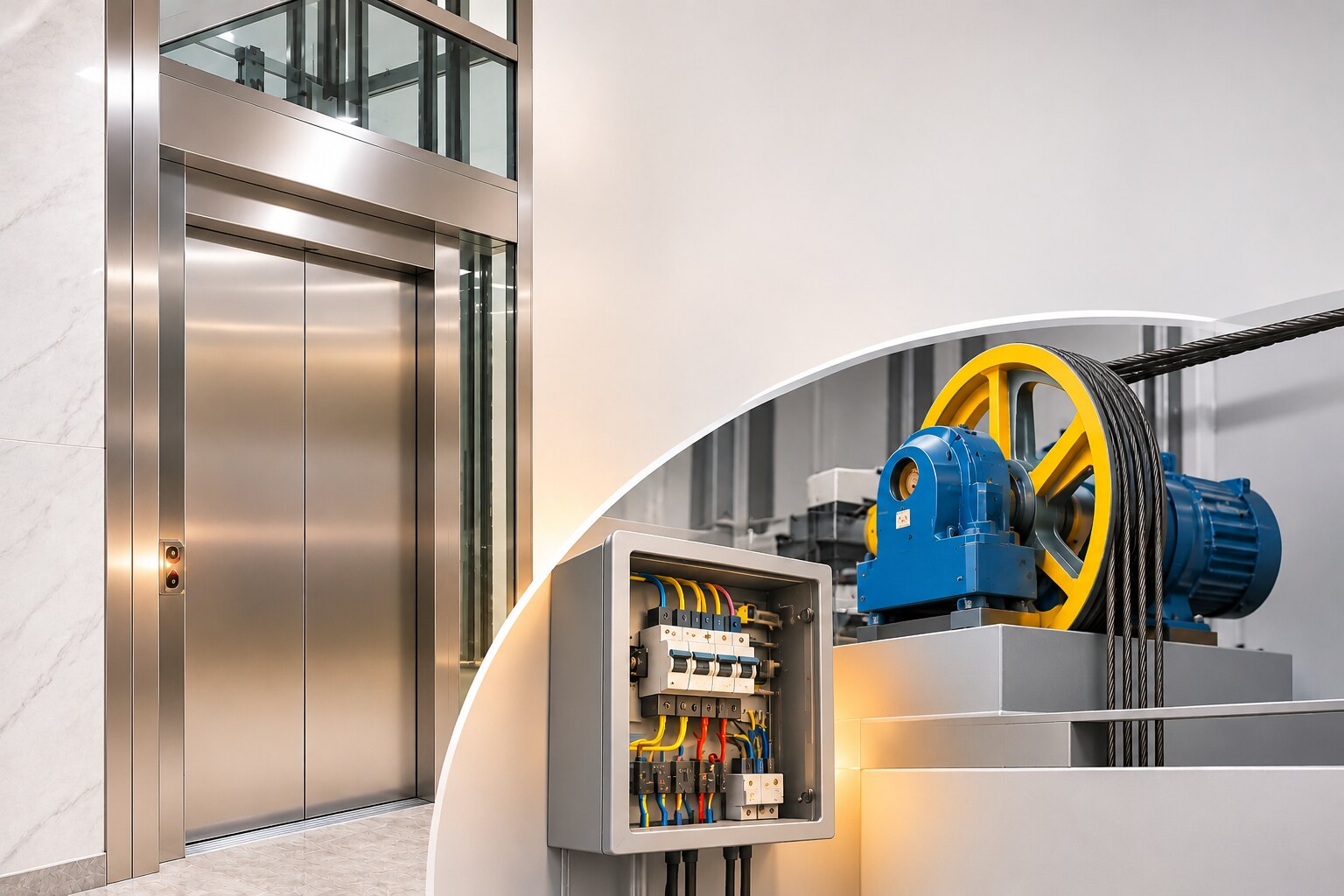
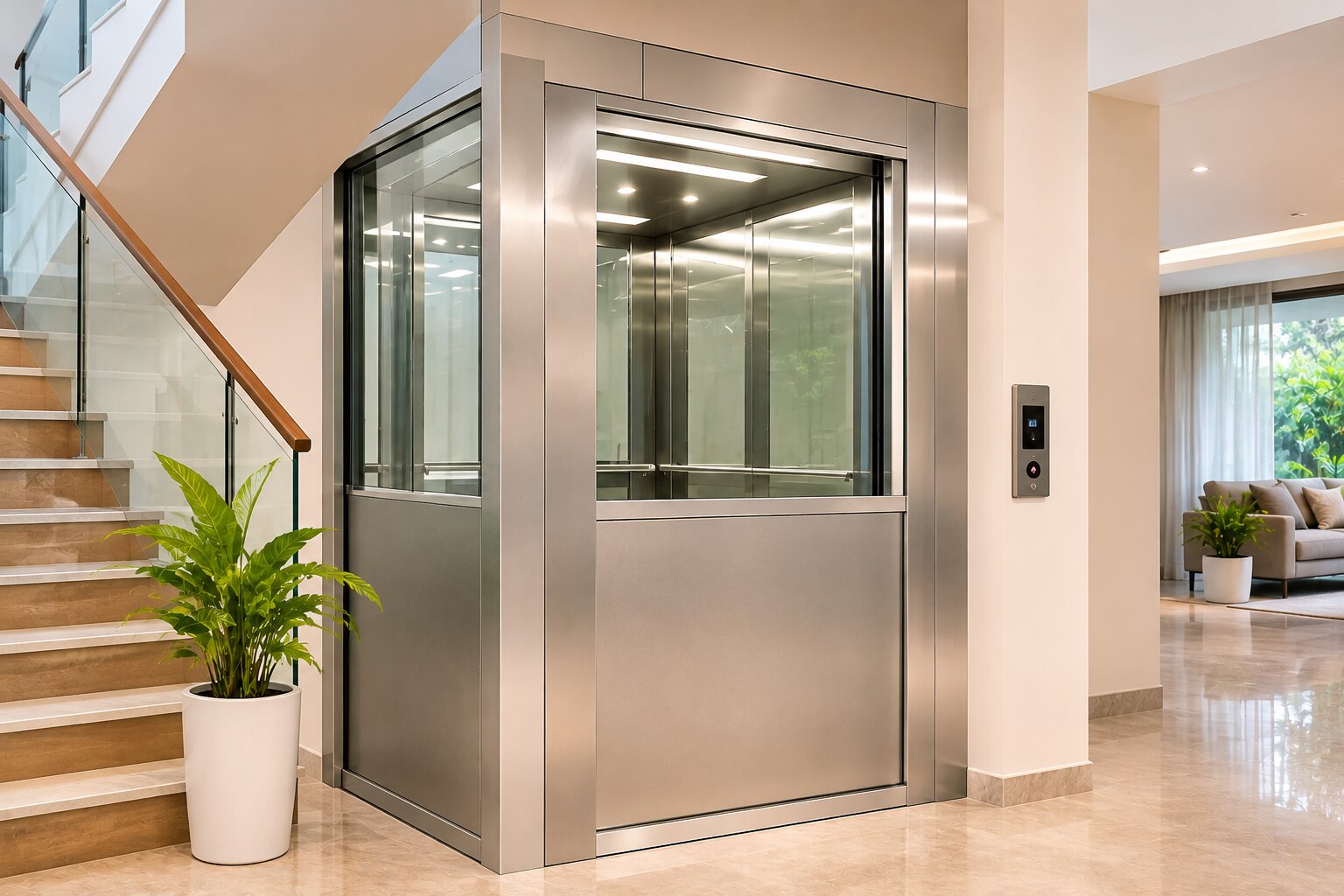
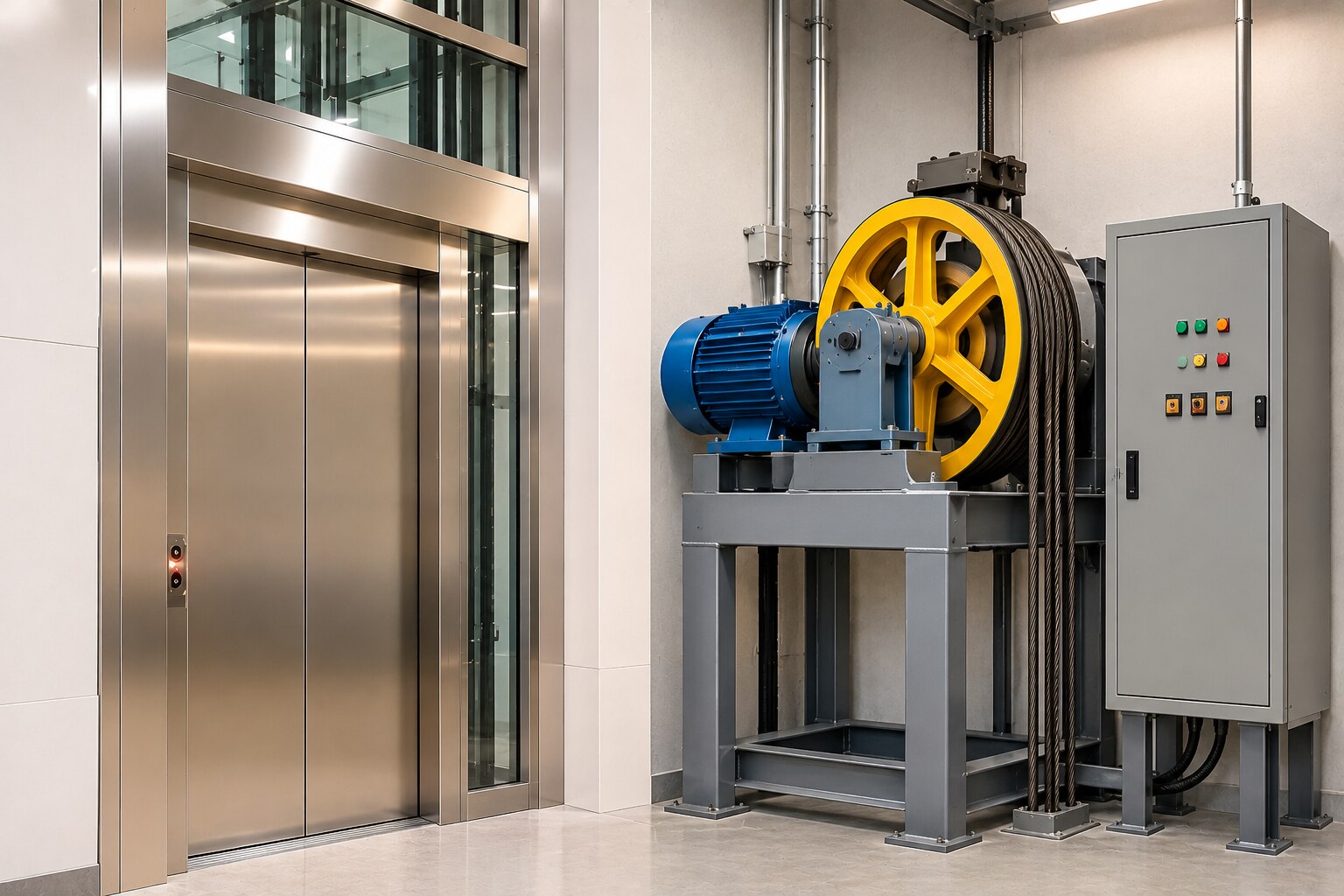
A “manual lift for villa in Surat” usually means a traction lift with manually operated landing doors, not a car lifted by hand. An electric motor turns a traction sheave; ropes passing over the sheave connect the car to a counterweight. The counterweight balances much of the car load, reducing the motor’s work.
The main parts must work as one system:
- The motor rotates the traction sheave in the selected direction.
- The ropes move the car and counterweight in opposite directions.
- Guide rails keep the car travelling vertically without sideways movement.
- The brake releases only for commanded movement and clamps the sheave when the lift stops.
- Car controls and landing call buttons send a travel command to the controller.
- Manual swing, collapsible, or telescopic landing doors give access at each floor.
Manual doors create an important user-dependent fault: someone can leave a door partly open, slam it out of alignment, or damage its rollers. A mechanical lock must hold each door shut, while an electrical interlock must prove that the door and gate are locked before the controller permits movement.
A door that looks closed is not safe evidence.
The lift must stop if any interlock opens, the overspeed governor detects excessive speed, or a safety circuit breaks. During a power cut, the spring-applied brake should hold the car, but it will not automatically bring passengers to a landing; automatic rescue equipment requires separate specification.
Keep the protected staircase independent, because a lift is not an escape route during fire.
What each common lift symptom is telling you
A traction manual lift for problems in a villa in Surat should be diagnosed by its symptom, not by resetting it repeatedly. Keep people out of the car and shaft, and call a qualified lift technician for any fault involving the brake, ropes, locks, or safety circuit.
- Will not start: Check whether the landing door and car gate are fully shut, the manual door lock is engaged, and the isolator or protective breaker has power. A door that looks closed can still leave its interlock open.
- Stops between floors: Treat this as a safety shutdown, power interruption, open-door circuit, or controller fault. Do not pull the brake-release lever or force the doors; uncontrolled movement can occur when the car and counterweight are unbalanced.
- Travels unevenly or stops at different levels: Ask for checks of guide rails, rail shoes, rope tension, brake release, levelling sensors, and floor accuracy. Do not blame the counterweight until those checks are complete.
- Makes noise: Grinding, scraping, or rhythmic knocking points technicians toward rail alignment, sheaves, bearings, ropes, or loose brackets. Stop using the lift if the sound suddenly changes.
- Will not close its doors: Clear the sill, inspect rollers and hinges, and check whether a manual swing or telescopic door is out of alignment. Never bypass the gate interlock.
These checks cover common traction lift problems in Surat; humid air, dust, and unstable villa power can expose them quickly. Record the floor, load, sound, and fault indication before service.
Which Surat villa conditions create or disguise lift faults
The quickest separation is this: a traction defect follows the lift’s movement, while a building-side fault follows the supply, room, shaft, or weather.
A car that jerks, vibrates, makes rope or sheave noise, drifts, or stops at inconsistent levels needs traction elevator maintenance in Surat, including checks of ropes, grooves, brake setting, guide shoes, alignment, and drive tuning.
| Condition | Clue pointing to the building | Clue pointing to the lift |
|---|---|---|
| Power failure or voltage fluctuation | Lights, fans, or other loads fail; voltage changes during generator changeover | Supply is stable, but the motor, brake, or controller still will not run |
| Earthing | Protection trips, earth-continuity readings fail, or metalwork gives a shock; isolate it immediately | Earthing passes, but the safety circuit opens during travel |
| Water or humidity | Wet pit, damp terminals, corrosion, or faults after rain | Dry equipment still shows the same travel or levelling defect |
| Ventilation and heat | Controller or motor trips after a hot machine-room period and recovers after cooling | The fault appears at every temperature |
| Shaft alignment | Rail brackets, sills, plumb lines, or clearances are visibly wrong; rubbing changes by floor | Rails and clearances are correct, but vibration follows speed or direction |
| Electrical circuit overload | The lift breaker trips when other villa loads start, or the circuit is undersized | A dedicated supply holds, yet the lift repeatedly opens its internal protection |
Do not repeatedly reset interlocks, governor trips, or safety gear. A spring-applied brake can hold the car during power loss, but only an engineered rescue device or suitable standby supply can move occupants to a landing; a lighting inverter cannot be assumed suitable.
What to verify before installing any villa lift
Confirm the final setting-out drawing before building the shaft. Check plumbness, pit depth, overhead refuge space, landing sill levels, rail-bracket positions, machine-support loads, and the route for delivering equipment. A common villa lift installation issue in surat starts when civil work fixes dimensions that do not match the selected car or door arrangement.
Verify these items on site and in writing:
- Structural: shaft walls, guide-rail fixings, machine supports, slab openings, and pit waterproofing must carry the specified loads.
- Electrical: provide a dedicated supply, correct earthing, protection, isolator, and a rescue system rated for the lift motor, brake, controls, and cabin—not merely a household inverter.
- Drainage: keep monsoon water out of the pit; confirm waterproofing, drainage, and a safe response to water ingress.
- Access: preserve the required stair, landing approach, maintenance clearance, machine access, and delivery route.
- Performance: record rated load, speed, stopping accuracy, noise limit, door type, fire-alarm behaviour, power-failure rescue, and applicable Gujarat inspection and operating approval.
| Option | Main checks | Best fit or limitation |
|---|---|---|
| Traction | Counterweight, sheave, ropes, rails, pit and overhead | Efficient for regular passenger travel; needs substantial structural accuracy |
| Hydraulic | Cylinder route, oil equipment, pit protection, heat and leakage control | Useful where overhead is limited; oil and drainage need attention |
| Screw-driven | Screw alignment, support, enclosure, speed and duty cycle | Suits light-duty use; verify noise and travel limits |
| Platform | Platform clearance, controls, guarding and accessible approach | A manual lift for villa in surat is not interchangeable with a passenger lift; confirm whether its performance meets your needs. |
How to manage power failure, rescue, maintenance, and handover
A spring-applied, electrically released brake should stop and hold the car during a power cut; it will not automatically move trapped passengers to a landing. Specify an automatic rescue device or lift-rated standby supply, not a household inverter intended for lights.
Keep the protected escape stair independent, and define fire-alarm recall, smoke exposure, and generator operation in the lift specification.
1. Ask the installer to demonstrate the emergency alarm, two-way communication, door-release procedure, car lighting, overspeed governor, safety gear, door interlocks, buffers, limit switches, and emergency lowering or rescue system. Never force a landing door or climb out between floors; call the named rescue contact.
2. Require a handover file containing approved drawings, inspection and registration evidence required by the Gujarat lift authority, test results, rated load and speed, rope and brake details, electrical diagrams, rescue instructions, warranty terms, and the maintenance provider’s contact details.
3. Put scheduled visits in writing. The log should record functional runs, door and interlock checks, brake performance, rope condition, leveling, batteries, alarm communication, earthing, pit water, and corrective work. Low villa usage does not prevent seized doors, oxidized contacts, or failed batteries.
4. Before appointing a provider, check who will respond after hours, who holds access keys, which technician is trained on the installed controller, and whether every safety trip is investigated rather than repeatedly reset or bypassed. This discipline addresses traction lift problems in Surat and makes traction elevator maintenance in Surat verifiable.
Shivangi Enterprises should hand over final setting-out drawings and train the owner against the actual shaft, controls, rescue equipment, and maintenance schedule—not a generic manual.
Frequently asked questions
What does a manual traction lift mean in a Surat villa?
It usually means an electric traction lift with manually operated landing doors. A motor turns a traction sheave, while ropes connect the car to a counterweight.
What do common traction lift symptoms indicate?
Door impact, uneven levelling, unusual noise, vibration, slow travel, or repeated tripping can point to faults in door locks, ropes, guides, brakes, controls, or power supply. A qualified technician should inspect the lift before continued use.
Which Surat villa conditions can create lift problems?
Heat, humidity, dust, monsoon water, poor ventilation, construction debris, and voltage fluctuations can affect controls, motors, door equipment, guide components, and electrical connections.
What should you verify before installing a villa lift?
Verify the shaft dimensions, pit and overhead clearances, rated load, travel speed, power supply, emergency access, landing-door arrangement, rescue method, maintenance responsibility, drawings, test records, and handover documents.
How should power failure and lift rescue be managed?
Provide a defined rescue procedure, emergency alarm, suitable lighting, and access for trained responders. Do not force doors or climb out of a stalled car; contact the maintenance provider or emergency service.
Keywords