A traction lift that stops during a power cut is usually held by its spring-applied brake, but passengers can still be trapped between floors or beside an unsafe door gap. Keep occupants inside, establish communication, identify whether the building or lift has lost power, and give the rescue technician precise information before anyone touches the equipment.
Key takeaways
- Keep passengers inside and use the alarm or emergency telephone.
- Check whether nearby lights and equipment also lost power.
- Use ARD information to assess the car’s position before rescue.
- Have a trained technician isolate, inspect, and test the lift before reuse.
Keep Passengers Inside and Raise the Alarm
Tell everyone to remain inside the car, keep clear of the doors, and use the alarm or emergency telephone to establish two-way communication. A traction lift power failure normally de-energises the brake coil, allowing the spring-applied brake to hold the car; it does not, by itself, indicate free fall.
The car is still immobilised until its position and condition are confirmed.
Building staff should take these steps:
- Ask occupants for the car’s approximate position, number of passengers, injuries, smoke, heat, or unusual noise.
- Tell them not to force the car or landing doors, climb through a gap, or step onto the roof of the car.
- Keep people away from landing doors and stop untrained staff from attempting a release or rescue.
- Call the authorised lift-rescue or maintenance team and provide the building address, car position, passenger count, and time of stoppage.
- Record whether the rest of the building has power, along with any alarm response or display message, without repeatedly resetting breakers.
If you are searching for “traction manual lift for loses power in surat,” remember that Surat monsoon water changes the response. Do not operate or re-energise the lift to dry it out if water, condensation, corrosion, or a wet pit, sill, machine room, cable entry, or controller enclosure is visible.
Isolate the area and tell the responding technician.
Separate a Surat Power Cut from a Lift Fault
If a traction elevator stops during an outage, compare the lift with the building before touching controls. Check corridor lighting, pumps, fire systems, and another lift. A site-wide loss indicates Surat utility supply; power elsewhere but not at the lift indicates building distribution, such as a feeder, isolator, MCCB, or phase failure.
Power at the lift isolator with a dead car indicates a lift fault.
- Record the stoppage time, car position, passenger load, and whether the outage affected other equipment.
- Check the lift main breaker, incoming isolator, and visible fuse indicators without repeatedly resetting a tripped device.
- Read the controller or VFD display for phase-loss, undervoltage, door-lock, brake, or thermal-overload codes. Note the emergency-stop and safety-chain status.
- Ask the authorised lift team whether the ARD operated, where the car stopped, and how occupants were rescued.
- Record the supply condition, breaker and fuse status, rescue method, and tests completed after restoration.
If utility power returns but the car remains dead, treat the event as an electrical or control fault, not a normal outage. During Surat monsoon conditions, isolate and escalate if the pit, sump, door sills, machine room, cable entries, or controller enclosure shows water, condensation, corrosion, or damaged insulation.
Water is never a reason to run the lift dry. This evidence makes traction lift troubleshooting safer and separates a supply failure from a brake, controller, door-lock, or maintenance defect.
Use ARD Information and Treat Each Car Position Differently
Car position changes the safe response after a traction lift power failure. Record the approximate position from the car indicator, landing display, camera, or occupants’ description, then keep the doors closed until an authorised rescue team confirms the condition.
| Car position | What it means | Safe response |
|---|---|---|
| Between floors | The car is immobilised away from a landing; its brake may have applied normally when power was lost. | Keep occupants inside. Do not release doors, climb through the gap, or try to move the car. |
| Closed at a landing | The car appears level, but the landing and car locks still need verification. | Do not force either door. Wait for controlled unlocking and passenger release by trained personnel. |
| Partly aligned with a landing | A step or shaft gap can cause a fall, even if the doors open. | Treat it as a between-floor rescue. Do not let anyone step out. |
Check the ARD label, controller display, event log, and battery status with the maintenance team. An automatic rescue device may only provide emergency lighting, alarm, and two-way communication; another unit may move the car to a landing before opening the doors.
Load, battery charge, travel direction, brake condition, and door-controller compatibility determine whether that movement is possible. A battery cabinet alone proves nothing.
Record whether the ARD operated, where the car stopped, and any fault code. Include those details in traction lift troubleshooting; repeated resets or improvised brake release can turn a manageable stoppage into uncontrolled movement.
Leave Manual Rescue and Isolation to a Trained Technician
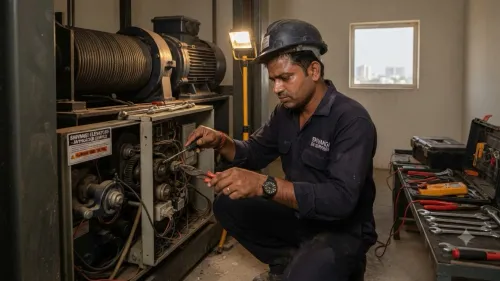
An authorised technician must establish two-way communication with passengers, prevent anyone from opening doors, and confirm the car’s approximate position before approaching the lift. Before moving it or opening the controller, isolate the supply under lockout/tagout, apply the specified discharge wait for the VFD DC bus, and verify absence of voltage with a suitable meter.
Opening the main isolator alone is not proof that the terminals are safe.
- Inspect the pit, sump, door sills, machine room, cable entries, and controller enclosure for water, condensation, corrosion, or damaged insulation. Water on electrical equipment means isolate and escalate; do not run the lift to “dry it out.”
- Follow the manufacturer’s rescue procedure and check the brake, counterweight condition, car load, and machine arrangement before any handwinding. Use the specified brake-release lever and control the handwheel; forcing it or releasing an uncontrolled brake can cause rapid car movement.
- Confirm the car is clear of people before opening equipment, release passengers only at a properly secured landing, and record the fault and isolation actions.
When requesting manual lift emergency repair in Surat, provide the building address, lift type, car position, passenger count, time of stoppage, power status, fault code, unusual noise or smell, recent repairs, and any water exposure. Tell the responder whether the lift has an automatic rescue device, battery lowering unit, or only emergency lighting.
Shivangi Enterprises can use these details to distinguish a rescue call from a controller or water-ingress inspection.
Related product
 | Traction Manual Lift Shivangi Enterprises – High-Performance Traction Manual Elevators Product Overview At Shivangi Enterprises, we specialize in designing and... View product → |
Test the Lift Before Returning It to Service
A successful restart does not clear a traction lift power failure. After a traction elevator stops during outage, keep it isolated until an authorised technician checks the equipment, including the brake, emergency or manual release mechanism, safety circuit, door locks, brake-coil supply, and controller or VFD fault history.
A VFD can retain dangerous DC-bus voltage after isolation, so never open the controller or touch terminals without lockout/tagout and verified absence of voltage.
Record these checks before anyone authorises passenger use:
- Confirm the incoming isolator, phase loss or phase sequence, undervoltage protection, control fuses, motor and brake thermal overloads, emergency stop, safety chain, and door-lock circuit.
- Inspect the pit, sump, door sills, machine room, cable entries, and controller enclosure for monsoon water, condensation, corrosion, or damaged insulation. Water on electrical equipment requires isolation, not a test run.
- Test leveling accuracy at each served landing, brake stopping, door reopening, emergency lighting, alarm, and two-way communication.
- Test the automatic rescue device or UPS under the manufacturer’s procedure, including battery condition and controlled landing operation.
- Record the outage time, car position, occupants rescued, fault codes, voltage or phase findings, test results, repairs, and the technician’s name and release decision.
| Condition | Required decision | Record |
|---|---|---|
| Power restored and all tests pass | Return to service | Test readings and authorisation |
| Fault remains after supply returns | Keep isolated; investigate, do not repeatedly reset | Fault code and isolation time |
| Water, damaged wiring, or failed safety device | Keep isolated and escalate | Location, condition, photographs, and repair order |
Frequently asked questions
What should passengers do when a traction manual lift loses power in Surat?
Tell passengers to remain inside the car, keep clear of the doors, and use the alarm or emergency telephone for two-way communication. The spring-applied brake normally holds the car when power to the brake coil is lost.
How can you tell a Surat power cut from a traction lift fault?
Check whether corridor lighting, nearby lifts, and other building equipment also lost power. If only one lift stopped, report it as a possible lift fault and keep passengers inside until assistance arrives.
What does ARD information tell you during a traction lift power failure?
An automatic rescue device can indicate whether the car moved to a landing and opened its doors after the outage. Treat a car stopped between floors differently from a car safely levelled at a landing.
Who should carry out a manual lift rescue or isolation?
A trained lift technician should perform manual rescue, electrical isolation, brake or door checks, and any movement of the car. Do not force doors, climb out, or bypass safety circuits.
When can a traction lift return to service after an outage?
Return it only after a technician identifies the cause, checks power and safety circuits, confirms door and brake operation, and runs the lift through its travel and landing tests.
Keywords